

The Virgil Abloh Effect
Zara Korutz's Research Helps Us Decode Virgil Abloh's Legacy-On a PhD Level.

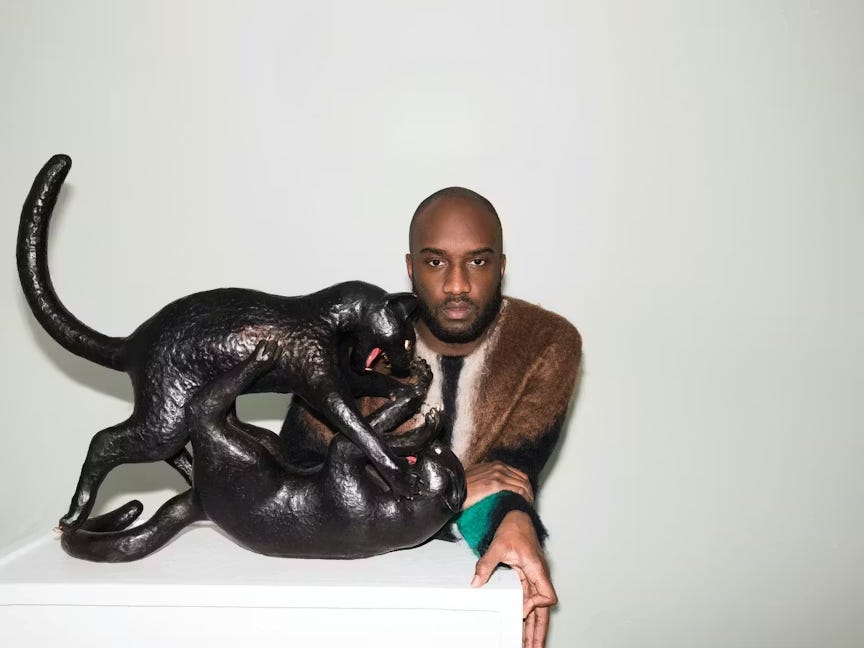
Virgil Abloh has always been a mystery for me—and I reckon for many others as well. I could see, I could almost sense the vision behind the work, and yet I was lacking—perhaps—the cultural background to put “a method” behind the madness. I’m not Black, I am not American, and I have minimal exposure to streetwear—that is, what it used to be before being commodified by big conglomerates.
Zara Korutz is a Fashion Studies PhD candidate from Massey University, School of Design, who has devoted her entire PhD research to decoding the man—and she even understands the perplexity of the signifier. “On prima facie,” writes Korutz, “selling a luxury aspirational dream using the visual and coded material language of the ‘streets’ can be a perplexing notion given that they appear to be polar opposites. Abloh was able to successfully usher the ‘streets’ into the luxury ecosystem by positioning cultural hybridity as a site of fashion innovation.”
In the following conversation, Korutz walks us through her research, explaining how Abloh created a blueprint for cultural translation that continues to inspire designers and creatives worldwide. I feel her work not only demystifies Abloh’s methodology but also reveals why his legacy remains so vital to understanding contemporary fashion’s role in bridging divided worlds.
So, how did this whole adventure start?
I went to Central Saint Martins in 2020, with no idea it would become the pandemic. I finished my MA degree in Fashion Critical Studies and fell in love with academia thanks to my course leader, Dr. Jane Tynan. I knew I wanted to continue my education and get a PhD.
Not knowing what to study, I remembered why I even went to Central Saint Martins in the first place. It was because I went to the Vogue Paris Fashion Festival in 2018, and there was a panel discussion with Virgil Abloh, who at the time, had just become the creative director of Louis Vuitton. He was in conversation with Alexandre Arnault, who was then the CEO of Rimowa. They were discussing the Off-White Rimowa collaboration, and they had a massive ad campaign all over the U.S. with the company I worked for at the time, the advertising company Outfront Media.
That conversation inspired and intrigued me. For the first time, I was hearing discussions on fashion from a very deep perspective that was intersectional, talking about culture and people. It inspired me so much that I came home and applied to grad school. At this point, I’d had a career for 15 to 20 years. I decided to leave that and go to Central Saint Martins to pursue academia. So it was because of Virgil.
I spoke with Vicki Karaminas, who is my incredible supervisor, and I said, “what do you think of Virgil?” And she said, “Yes.” He had just passed at the time, so there was a lot of recognition around his career that was cut too short. It felt right. That’s how it all started, and I’m very happy with that decision. I’m very deeply passionate about this work. Academically and intellectually, Virgil is deserving of the depth of rigor that a PhD project undergoes.
In 2020, Virgil Abloh outlined what he called his “Streetwear Style” methodology — a “system of thinking” about understanding the now, in both digital and physical worlds. How do you interpret that statement? What does it reveal about the way he approached creativity?
I use Virgil’s own words in my research as a starting point because he was such a prolific communicator, documenting his own thoughts, work, philosophy, and ideologies. He uses the term “streetwear methodology” himself in the CAFA lecture—the China Arts College lecture—that he gave. He refers to how he is positioning his work as a movement. It’s a methodology because it’s applicable, but he frames it within the other art movements that have come before, like the Renaissance.
If you look at how he’s framing his work, he does this to give it gravitas. Communication is so important at work. Before, streetwear was a subculture that was designed for insiders. The language was adopted and accepted because everyone who participated was familiar with its cultural meaning. By Vrigl communicating the coded language of streetwear through the historical lineage of the classic artistic eras and art movements, he placed streetwear into the lineage of the arts.
But someone might say using the language of the street, of streetwear, and eventually selling luxury items sounds contradictory. Yet he made it work. What was the element that made it work?
I would ask first, what would be contradictory? You’re saying they’re two different worlds, and I think you’re exactly right. That is the point or question that begs to be asked: how does this work?
If we look at streetwear, it comes from the streets. If we look at hip-hop, for example, which is a very important element to streetwear culturally—including music —it comes from, in America, a lifestyle and community of Black, brown, and immigrant people. Communities that are often struggling to survive in the city, to make a better life for themselves, often do so through becoming athletes or drug dealers. There’s a lot of insidiousness and violence around the idea of hip-hop as a culture. We hear about the “streets” lifestyle in hip hop music.
If you look at rap music linguistically, it’s an art form, and it often talks about the functionality of street style. For example, Jay-Z talks about the violence associated with streetwear and the use of boots and puffy coats to hold stashes of drugs, to hold guns, as personal armor. In this sense, streetwear is a functionality of survival.
So one can say that hip-hop comes from the opposite of luxury—it’s considered illicit. There’s a historical criminality associated with streetwear, which is very interesting because luxury, on the flip side, is viewed as not only legitimate but superior and protected from that illicitness.
The duality of what you’re talking about is what makes Virgil’s work so importantly impactful. He calls duality his “Trojan horse,” a methodology—conquering something from within. But it’s deeper than that. When you think about what he really did, bridging these bipolar worlds, it’s almost miraculous.
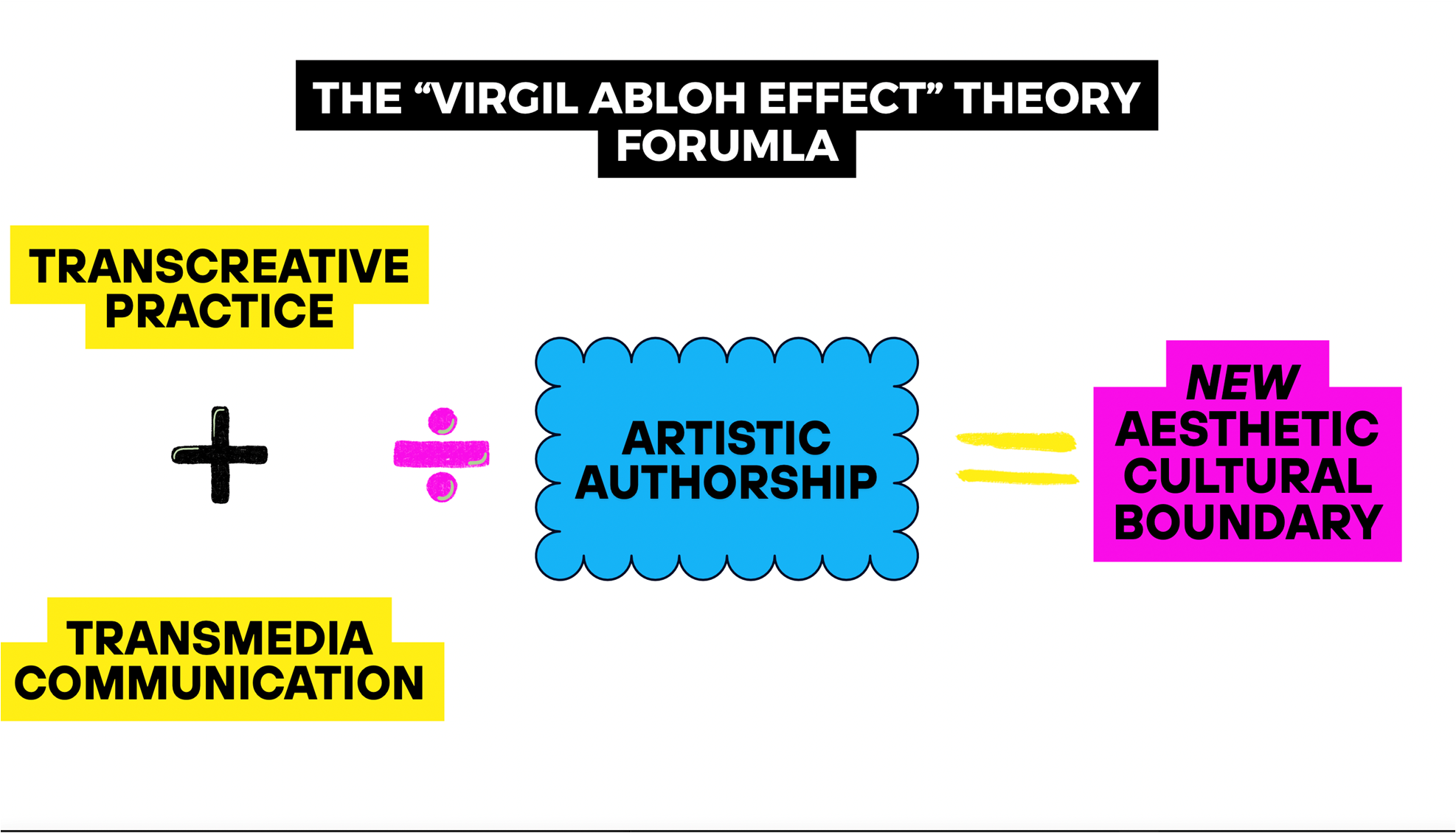
You’ve also developed something you call “The Virgil Abloh Effect,” which you frame as an academic structural theory. Can you walk me through the formula — transmedia communication plus transcreative practice divided by artistic authorship — and what it means in practice?
I want to go back to the idea of the physical and digital world first, because that’s the starting point. I view Virgil’s work, and him specifically as an artist, because I do think, and I say this very blatantly, fashion is art, and art is now a multiplicity of anything. We’ve been freed from the meaning of what art is with postmodernism in the 1960s. So, if we frame whatever the output is as an artistic practice, then that gives us the freedom to say: how are we connecting to it?
Then what becomes important is the multimedia language of how we connect to that art form. Virgil did this beautifully through the written language, through the oral language, and through a multiplicity of digital media, including film for storytelling.
If we know that the output—the result—is that Virgil Abloh and his work changed boundaries by removing them and creating new meanings, the question is: how did he do that as a blueprint? That’s what everybody wants to know. Other creatives want to be like Virgil. It’s not enough to just say look at his “3% rule.” But what does that really mean?
People are asking for a blueprint that they can become their own change-makers. The idea of “Virgil Abloh effect” is not new—you see the phrase used in journal articles, it’s colloquial, this idea of being like Virgil. But I take the academic perspective to say this is actually a theory that we can deeply understand, dissect, and then it can become applied.
Can you explain the formula in practical terms?
It’s a very basic mathematical formula that I imitate. I am horrible at math—I still have to count on my hands and fingers. So it’s very simple: one plus one divided by equals this.
My “one plus one” is trans-disciplinary creative practice. The key word to understand is “trans.” Everybody used to say “interdisciplinary”—bringing this, bringing that in. It was a way of bringing together. Now we’re not just bringing together, but we’re working across. We’re removing the boundaries between two things and connecting the dots to solve complex problems.
So: creative practice—anything that’s creative, whether fashion, food, film, photography, performance, sculpture, poetry, literature, critical thinking, any sort of creative practice in that traditional open-ended sense—plus the medium. How is it being consumed? Is it written? Is it an object, image, or text? Is it sound?
The formula is transdisciplinary creative practice plus transmedia communication divided by the artist’s worldview equals a new cultural meaning. The “Virgil Abloh Effect” formula is the blueprint for how to understand change.
Someone might say this is a very postmodern or post-postmodern phenomenon—mixing everything. Is that a negative thing?
I don’t think it’s negative. I think it’s the zeitgeist of what we’re living in. This is the reality of our era, whether we like it or not. This is the life we’re living.
When you eliminate boundaries, isn’t that also a class issue, a status and class issue? Virgil did make an impact in changing the class structure within fashion.
We can call this era we’re living in either post-postmodernism or metamodernism. This era—and many scholars talk about this—is the liberation and restructuring of Kimberlé Crenshaw’s late-’80s model of intersectionality: gender, race, ethnicity, religion, all of the above. Any sort of Foucauldian norm of bias, really. It’s a separation of what was and now a new opening of what is. We’re in a new era.
The financial structures of those who hold 1% of wealth in the world have changed. How we go about defining and getting wealth has changed. Whether we want it or not, it is what it is—how the world is now shaped, how it functions, and what that means culturally for individuals and identities. What Virgil did so well was that he understood this change. He was able to translate it. Then he was able to build a community around it.
In the ‘90s, we saw the tech era, the internet era, as a new boom of connecting the world. It did that, but at the same time, it brought people together while separating them and promoting the approach of success being divided and singular. It created this divide.
Now, in the metamodern era, or the post-postmodern, we’re having to create a cultural community again that exists in real life but also exists digitally. We’re in this dynamic where belonging works across boundaries. Belonging comes from: what do we have in common? What do we resonate with? Who are we? How do I find my people?
I very much believe in next-generation communities. I see them both online and offline in the weirdest of places. Yesterday, I was checking Reddit—there’s a whole Reddit thread about fake luxury bags. We’re living in a deepfake world.
Do you feel that what Virgil did actually helped people get a voice in the official fashion calendar that they normally wouldn’t have?
I don’t know about the fashion calendar—that’s a whole separate debate. I do struggle with that. It’s a very old hierarchical system that deserves examination and needs change. To answer your question: yes, Virgil gave voices to the voiceless by bridging and transplanting the voice that was already heard in one community and sharing it with the other. I view Virgil’s work in totality as that of an ambassador and translator.
What he did was connect audiences that would not necessarily connect on their own. There’s a language behind that, and you have to be able to speak both languages. There’s a duality to that—it’s no different than being bilingual. He was able to translate culture as a language.
Normally, people who belong to street culture would not communicate with the white European aristocracy, and vice versa. But when you bring these two groups together and you translate, then all of a sudden you start seeing: oh, you know, business. I know business. This is what you mean by this. Oh, I like that. Then you start sharing. You find the commonalities. You start really seeing the similarities of how you actually connect rather than the divisiveness.
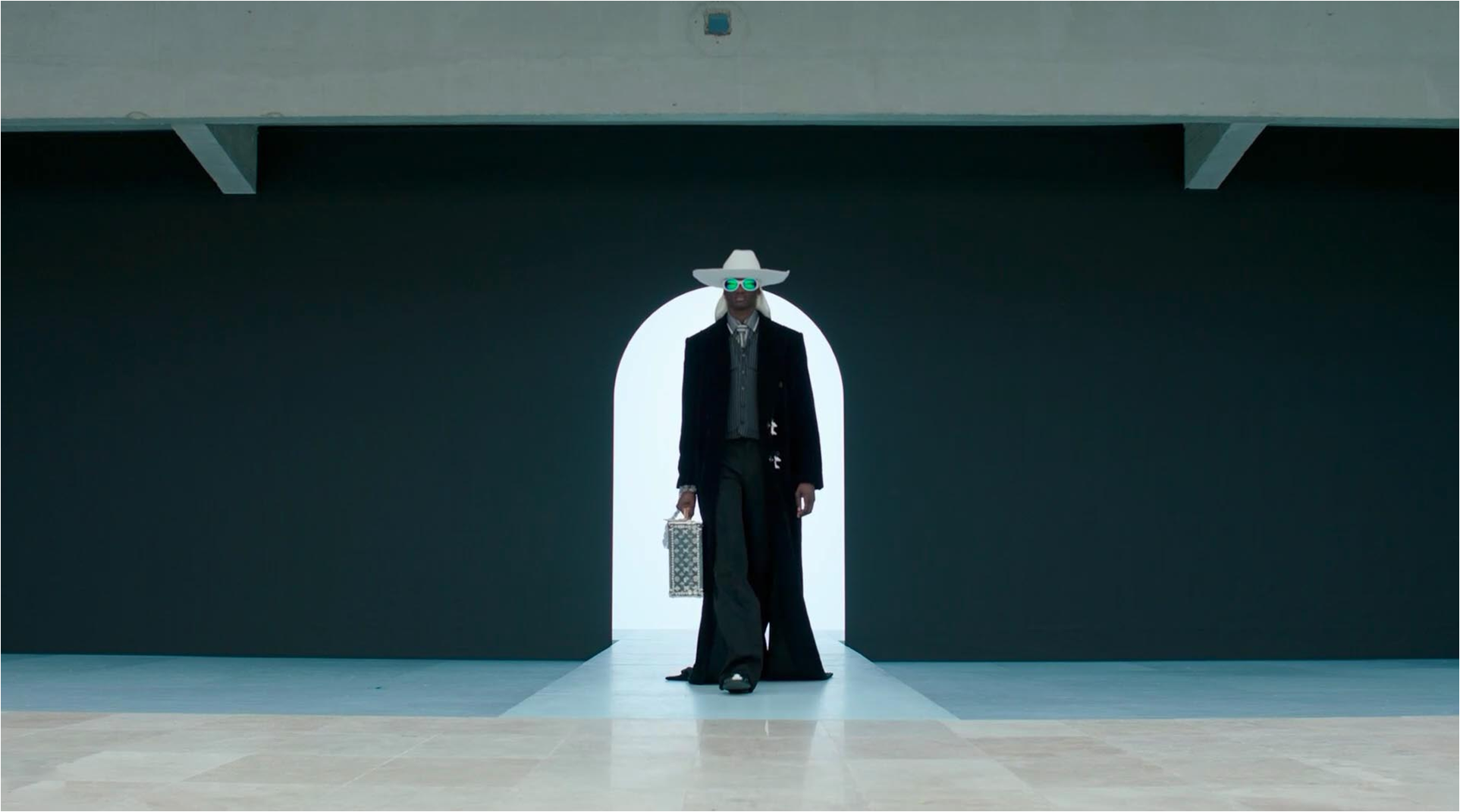
I felt that when it comes to brand strategy, he had a pioneering sense of using words as part of an irony system. He used words on things as signifiers, trying to build foundations beneath something and make it not that stable, suggesting there’s something more than what you see and read.
I think not taking things too seriously on the surface allows you to go deep. I think of Alexander McQueen—he is quoted often as saying all the time: “It’s just fashion.. Don’t take it so seriously.”
The idea of humor and laughter is disarming. When you look at Virgil’s work, he was extremely deep. When you look at his show notes, it is a literal dictionary of meanings. He goes into the depths of where the model came from, their name. It’s not shallow at all.
Humor and irony become an access point of common entry. It’s like René Magritte, when Magritte says, “This is not a pipe,” and Virgil says, “I have maybe this, but don’t take it that seriously.” It’s within this disarming that people feel comfortable entering the conversation.
This is what I talk about as the essential part of the formula for the Virgil Abloh effect: the artist’s objective worldview. At this point, the artist is now the translator, the communicator. They’re able to guide the conversation. They’re able to connect dots. They become essential to the aesthetic output at the end. It’s how they’re doing it, what they’re doing, and it really places the artist into the essential role of whatever the output is.
I think oftentimes, especially in fashion, the artist is considered a producer or they’re considered a lone genius—it’s a figurative, maybe false ideology of what they are. Really, when we look at the artist in the sense of Brian Eno, when he talks about the idea of scenius, it’s a grouping, it’s a collaboration of like minded people.
That’s why working across boundaries and mediums and creative practices with artists working together in this collaborative spirit connects to many people. That’s why the artist and the vision and who they are are essential.
That makes me feel this is a development of the role of the artist. The artist is now more like a communicator,in all this fragmentation, they’re the one who’s able to connect the dots, connect the pieces, and guide a community toward something new.
It’s essential. Fashion is always a little bit late to the game. Institutional thinking that fashion holds likes to place the fashion designer as playing the role of presenting as an artist. Then they love to go back to: “Oh, well, back in the 1920s, the fashion designer emulated this or that artist like Salvador Dalí.”
They did not emulate artists. They were living and breathing their own art form with other artists. It’s essential for all of those who know how Coco Chanel or Elsa Schiaparelli lived their everyday lives—it’s basic learning.
That’s why now the idea of celebrityism is only as good as the celebrity who’s able to communicate on a multiple-platform basis. It’s not enough to be singular anymore. You have to have multiple modes of communication to be able to translate or communicate what it is you’re trying to say.
Last question: going on this journey from conception to now, toward the end, what is the thing that made you feel most: “It’s worth it, what I’m doing”?
The community of people. When I talk to a young designer in Africa for whom Virgil is an icon or hero, this is what makes the work matter, because Virgil mattered. He changed so many lives, and everything he did was to help people.
I feel very honored and privileged to talk about Virgil and research his work because of the community of people. Virgil’s name has become a code word. If you know Virgil Abloh, then you know that you’re cut from the same cloth and you’re doing something innovative. You’re trying to change the world. You’re smart. You’re intelligent. You’re thinking. There’s a multiplicity to you. Instantly, I know that you’re an incredible person. That’s a blanket statement, but that’s been my experience running into people who are part of the community that adore Virgil and his work.
It’s the community that is inspiring—seeing the postmodern Virgil scholars like Jakarie Whittaker and the work that they’re doing. I didn’t know I would find this level of connection and relationship with other people in fashion. I just knew Virgil impacted me personally. This man, whom I didn’t know, changed my life. I dropped everything. I moved to another country because he inspired me. That was the level of human connection.
Studying Virgil for my PhD has allowed me to feel even more connected to myself in a very empowering way. It’s this idea that who you are matters, and the work that you do matters–the idea of impact on the world. That’s the legacy of Virgil Abloh..
I think I commented on your preview note the other day asking if you had read Robin Givhan’s new book on Virgil Abloh & I’m so glad I caught the alert when the post went live! Zara is great. The reason I was asking about Givhan’s new book is bc she famously wrote negative critiques after his runway shows and she doesnt shy away from that in the book either. But even though she wasn’t the biggest fan, she admits it’s impossible to deny the impact he had on culture, customers, etc. I would be so interested to know of Zara, who seems like a certified fan, had the opposite experience and perhaps had to come to terms with some parts about Virgil Abloh that she didnt love? Just curious!
Hi Becca! I appreciate your thoughts and you bring up a good point. The idea of subjective "good taste", meaning what is good or bad and who gets to decide. This idea goes back to a hierarchical design principality that is often used to exclude aesthetics using a biased power dynamic. The negative judgements on Virgil's designs often centers around the concept of "originality". This subjective notion also comes from the POV of him somehow usurping the fashion system. I see those opinions now fading because not liking Virgil's work somehow seems less important in the scheme of what he did to impact change. Which Robin talks about in her book.