

The Last Emperor's Clothes
"I am Valentino. I live in my own world.”

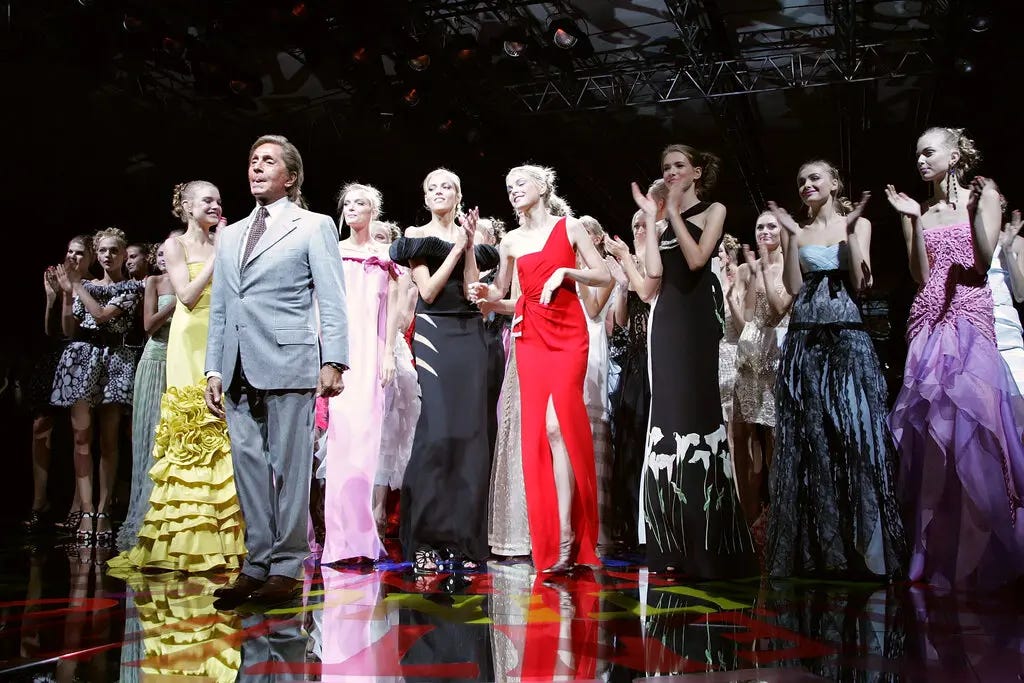
It’s true, fashion loves easy digestible creation stories. Think: Chanel freed women from corsets, Dior gave us the New Look, Saint Laurent put women in tuxedos. These stories are, in most parts, true but tidy and easily marketable to a mass audience eager to consume myths and clean-cut narratives.
Valentino Garavani didn’t play by these rules. He kept a manner of work often uncomfortable for an industry obsessed with obvious hype marketed into ‘revolution’, and yet, his influence proved more enduring than those designers who chased novelty and social media stardom like addicts.
Valentino, if we are to call him what he was, was a soft innovator. One who pursued pure beauty so relentlessly that he involuntarily changed how women dressed without ever pretending to reinvent the wheel. While his contemporaries were busy deconstructing and ‘disrupting’, Valentino was doing something far more subversive: perfecting couture-like tailoring to enhance the inner beauty of the women he dressed.
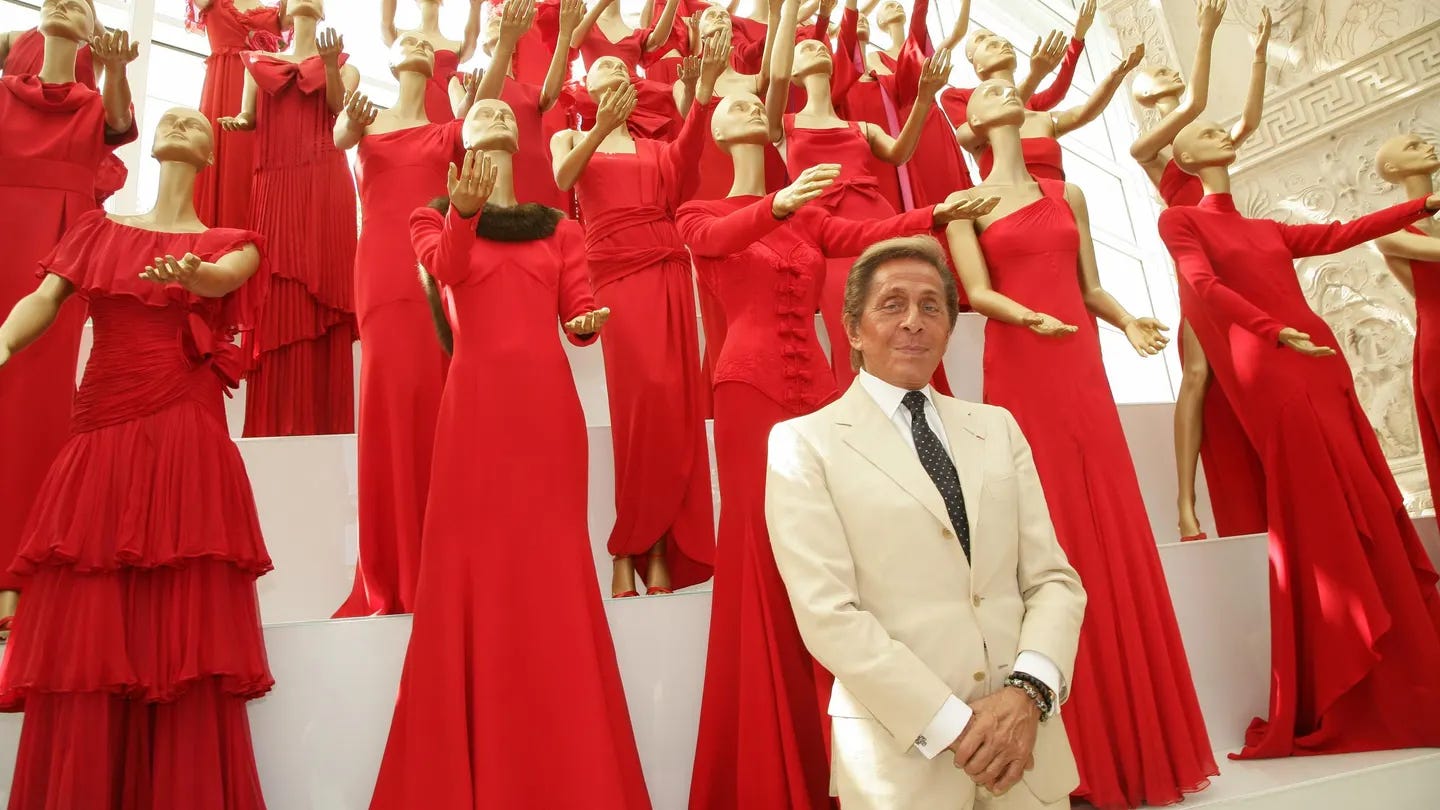
Red as Intellectual Property
The origin story of Valentino Red has the weight of legend. A chance meeting with an elderly woman at Barcelona’s Opera House, draped in magenta velvet, burning through the visual noise of safe colors—white, black, navy—touched something deeply personal, almost archetypal in young Valentino’s psyche.
“Among all the colors worn by other women, she seemed unique, isolated in her splendor,” he recalled. “I think a woman dressed in red is always wonderful; she is the perfect image of a heroine,” he noted. And he never forgot the revelational encounter. Later on, when he opened his first atelier in 1959, that Barcelona vision became a philosophical doctrine, an idea of ideal beauty standing still within a rapidly changing world.
He introduced his Valentino red, not scarlet, not crimson, but a cleverly calculated mix of carmine and scarlet with a hint of orange via a strapless cocktail dress in draped tulle. Since then, the shade didn’t just appear in his collections but rather became as much a signature as any logo. Valentino Red served as an indelible mark that forced the fashion world to reckon with a radical idea: a designer could own a color.
Through his sophisticated use of it, he subversively nodded to classicism as a sort of ethereal provocation, linking ancient divinities and mythological creatures to pleated silk dresses, connecting Roman matrones and queens to airy tulle skirts. He understood that in an age of mechanical reproduction, true ownership wouldn’t come from silhouettes anyone could conceive, but from sensory experiences that bypassed the brain and struck the gut. The sound of organza, the movement of tulle, the sensory overload of velvet-that was Valentino.
Couture Standards in a Ready-to-Wear World
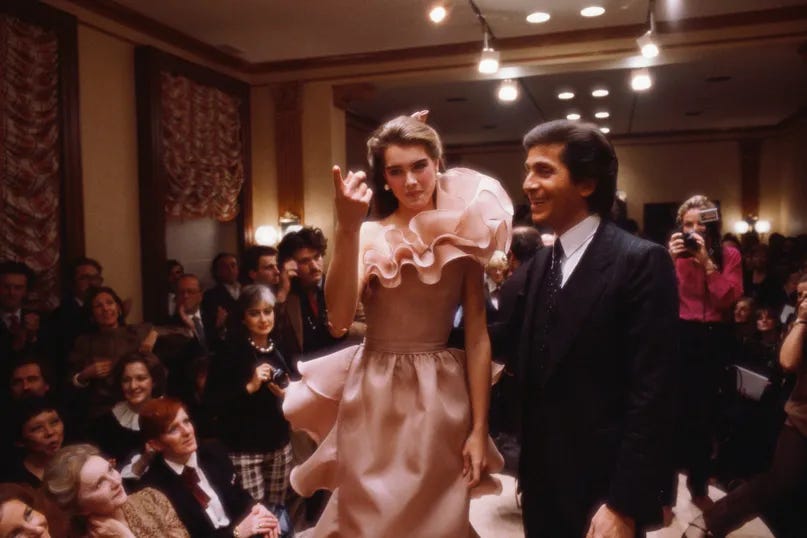
The 1970s and 80s saw fashion houses gleefully cutting corners to meet ready-to-wear price points and increase production schedules. The industry was learning to think more like manufacturers and ‘creative directors’, not designers. In reaction, Valentino committed to what theoretically should have been a commercial suicide: couture-level finishing in prêt-à-porter.
Opposed to this radical industrialization, he chose hand-finished seams where no one would see them, elaborate hidden interior construction that took hours, and intricate embroidery reserved for one-of-a-kind pieces destined for department stores. Think of the exclusive budellini technique alone: long strips of sheep’s wool hand-rolled into tubes, wrapped in silk, stitched together. In short, Valentino employed total luxury as a rebellion against the very transformation of fashion into a fast-paced mode.
An Unapologetic Aesthete
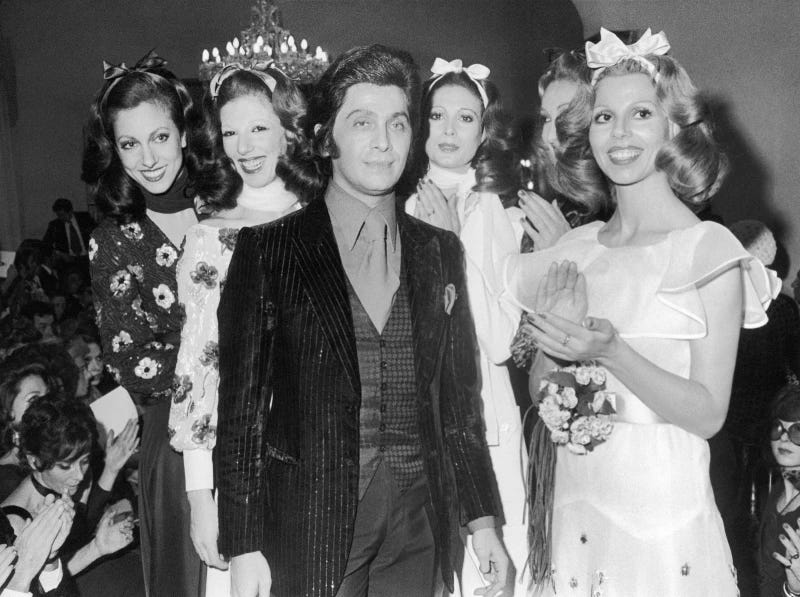
What I feel is his strongest legacy, though, is that Valentino never pretended to be anything other than what he was. “I love beauty, it’s not my fault,” he declared in The Last Emperor, the documentary that laid bare his world of cute pugs, super yachts, and elaborately decorated châteaux. When asked about being called The King, The Emperor, The Icon, his response was magnificently unbothered: “I am Valentino. I live in my own world.”
That world—one that “shuts out all that is not beautiful,” as Matt Tyrnauer, the director of “Valentino: The Last Emperor,” observed— set a standard of the designer, the couturier as a fellow aristocrat, a part of his tasteful audience. Most importantly, he ranked alongside Giorgio Armani and Karl Lagerfeld as one of the last designers of a generation who truly designed and owned their silhouettes before fashion became an industry run by financiers and marketing executives. For Valentino, consistency in one’s vision reads as true radicalism, a personal refusal to evolve past one’s vision in an industry that fetishizes change.
Valentino’s most important innovation wasn’t in what he made. It was in how thoroughly refused to make anything else.