

The Kit as a Confession
World Cup Teams ‘ Uniforrms Have a Lot To Say to Those That Can Listen

You may not believe it, but I passionately watch the World Cup. And being a fashion nerd, I can’t help but feel there is something almost too neat, too perfect about Loewe dressing Spain. And that took me inside the rabbit hole of team kits and what they represent.
Imagine that: the house known for its surrealist, cerebral work, built over eleven years into a temple of, as many say, visible intellectual labor — outfitting the squad whose footballing philosophy was constructed on the precise opposite principles. Spain’s Tiki-taka, if we view it at its theoretical purest, was a system where the player dissolved into the pass, allowing the self to be subordinated to the whole. Xavi, Iniesta, and Busquets are not stars in the conventional sense but nodes in a network, offering their greatness only in relation to one another. The ball moved; the people were a team.
And now here is Loewe, draping that same national identity in wide-leg suit pants and three-button blazers with a hidden striped cuff that reveals itself only when you know to look — offering a tiny theater of concealment and disclosure, a surrealistic echo of the above.
Which raises a question that the torrent of World Cup fashion coverage has, characteristically, declined to ask: when a nation dresses itself in a house’s visual language, whose vision is it actually wearing? How can a kit tell the visual story of its country when luxury brands come in and add their own distinctive touch?
This is the thing about the kit as a political document. Today, it is always, necessarily, a document written by someone other than the nation it represents.
Roland Barthes, writing in Mythologies, described how objects of everyday life become vehicles for ideology that presents itself as nature, as simply the way things are. The national football kit is a nearly perfect Barthesian myth: it appears to represent a nation’s essence, its character, its footballing soul.
Nowadays, though, it has become a tool to represent a series of corporate and creative decisions made at considerable remove from anything the nation would recognize as itself. The history behind the team isn’t necessarily taken into account. The collective soul is ignored as the sign points inward.
Cultural studies scholar Jennifer Craik, in “The Cultural Politics of the Uniform,” argues that the uniform does not simply dress the body — it disciplines it into legibility. In that sense, the uniform makes identity readable as it collapses the individual into a type. What the World Cup kit does, in this reading, is collapse an entire nation’s visual identity into a colorway, a badge, a design reference. Spain becomes surrealism. France becomes effortless. The complexity that would resist the uniform is missing; the actual self isn’t there.
Shall we blame high-end fashion collaborations for this?
Let’s return to our initial paradigm: Loewe and Spain, a house defined by surrealism and the visible seam of thought, dressing a team whose glory was built on the erasure of sole individual expression. There is a strong sense of structural irony here, one that makes someone wonder, in a Sartrean manner, about the existentialism of the player on the pitch.
Simon Porte Jacquemus, a designer whose entire brand mythology rests on Provençal light and effortlessness performed with precision, paired with the French national team, whose footballing culture oscillates violently between collective genius and Mbappé-cemented spectacular individual ego. The pre-match jersey is entirely blue, chalk-pinstriped, the cockerel emblem reduced to a sole whisper. It is, above all, tasteful.
And yet, for those who remember: France, famously, was not always tasteful on the pitch. Zidane was not tasteful. Cantona was not tasteful. But Jacquemus is, and so Les Bleus wear the tasteful version of themselves to the warm-up. The contradiction goes unremarked and gives the team a whole new identity — their projected collective myth of the French soul is more Emily in Paris than La Haine.
Gabriela Hearst, born in Paysandú, Uruguay, seventh generation of a merino sheep ranching family, designed Uruguay’s off-pitch suits from wool sourced from ranches in the north of her country. The fabric traveled from the Flores region’s Lanas Trinidad mill directly into the garments. The crest was placed inside the jacket — close to the heart, as Hearst herself explained — rather than on the breast pocket. A rare moment where branding gave way to collective biography. And I cherished it.
The Mexico kit tells a parallel, and more complicated, story. Adidas partnered with Someone Somewhere on the team’s third kit, hand-embellished by 150 female artisans from the Sierra Norte de Puebla region. Each piece carries a QR code linking directly to the profile of the artisan who worked on it. The intention was to make visible the human labor usually hidden behind the fashion object, and it is genuinely interesting.
As usual, controversy followed almost immediately, with critics questioning whether the artisans were fairly compensated. The story behind the story, the one the QR code was perhaps meant to preempt, or perhaps meant to answer, or perhaps simply meant to aestheticize into manageable form. We will never know for sure, but we are free to speculate.
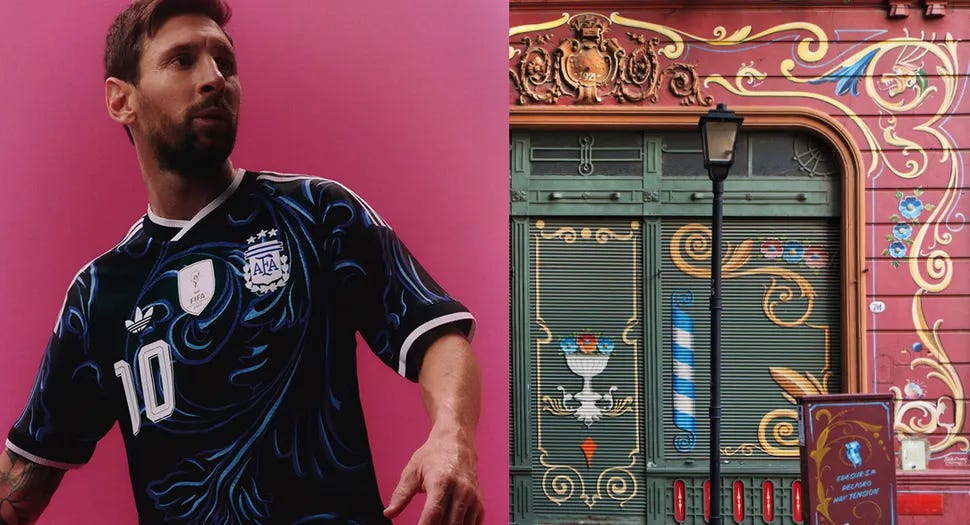
Argentina’s away kit, designed with reference to fileteado — the traditional Buenos Aires decorative style found on signs, taxis, and storefronts — produced a different kind of controversy: artists questioning, as Creative Bloq noted, how faithfully the design reflects the traditional lines of fileteado. The cultural reference is present, but the culture that produced it is not in the room. This is precisely the tension Craik’s framework would predict. The uniform claims to represent; it cannot consult. It speaks for the body it dresses, and the body has no right of reply.
The World Cup kit isn’t just clothes. Every design choice is simultaneously an inclusion and a suppression. Today, more than ever, I feel that every squad kit is a confession. It confesses what a nation thinks of itself, or more precisely, what a fashion house thinks a nation should think of itself. Spain in Loewe surrealism, now executed by Anderson’s successors. France in Jacquemus's effortlessness, Uruguay in Gabriela Hearst’s traceable wool. The United States in Virgil Abloh’s archive — a dead designer’s gestures redeployed to give the host nation cultural credibility it hasn’t earned on the pitch.
The question is whether the nation being dressed was in the room when the choice was made, or whether it was simply measured and told to show up in whatever arrived. In most cases, the answer is the latter.
Wow really loved this one! From the sound of it, I'm not nearly as close of a fan as you are, when it comes to football (I might be the only one in the States that feels the American sport does not dignify to the same name), I'm sort of take it or leave it. So reading this I learned a lot. First, I didn't know about these designer collabs. It's interesting. From a business perspective, it's smart esp the growing ovrlap between both fashion+sports industries and consumers. But as you pointed out, which side of the deal is shaping this narrative? I have other questions, lol, but for now I shall digress. I wonder if some partnerships will be on repeat every year, for lack of better options... def interesting to watch. Now I'll be following along. Thanks for sharing!