

The Devil Wears Prada Was Never About the Coat Montage
Costume Designer Molly Rogers Pushes Back on the Film’s Own Myth — And Explains Why She Designed the Sequel To Resist Being Dated to a Single Season.

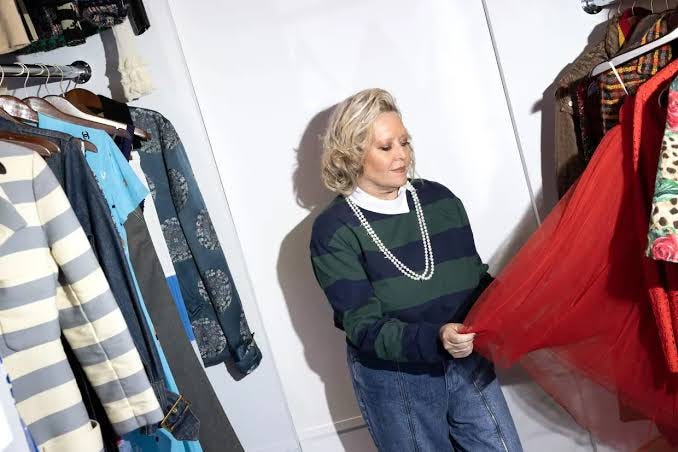
Somewhere in this conversation, famed costume designer Molly Rogers describes two nearly identical vintage belts as “the green” and “the cerulean blue” — and it’s hard not to hear Miranda Priestly’s voice underneath her own. Rogers, who cut her teeth at Patricia Field’s legendary store before shaping the iconic wardrobes of Sex and the City, And Just Like That..., and now The Devil Wears Prada 2, has spent four decades proving that taste isn’t a swatch you can screenshot. Instead, it’s a lifetime of experience and experimentation.
I was fortunate enough to sit up with her and talk about algorithms flattening our eyes, why the best belts are always vintage, and why she’d rather champion an unknown designer’s caftan she really loves than dust off another award.
It all started in New York in the ‘80s?
I started working at Pat’s store,she had a very famous store in the ‘80s. Through Pat, her store, the styling, getting more interested in clothing — all of that led into television and film. It all started with Patricia.
I never really thought I’d become a costume designer growing up. I loved to read, I loved to write. It was just through working at her store that I started assisting her, helping her. She got so busy and in demand, and so did I. It kind of happened naturally, it wasn’t something I set out to pursue.
Did those other interests — the writing, the reading — actually help you get good at what you do?
Yes, definitely. There’s a part of it that’s a heightened sense of style — knowing what looks good on a real person’s body, not a model. As you get more experience, you refine your taste, you learn what works on actors, men and women — you just get better with time. But it’s not all about your fashion eye. It’s so much about your education, your knowledge.
Pat is a crazy lover of history. It’s how much you’ve traveled, how much you’ve read, not living by an algorithm. Exploring on your own makes you a much more well-rounded person, and that’s really important when you begin to translate a script and bring your own perspective to it.
That takes a personal sense of taste and style. There’s a lot of discussion these days about “taste level,” if you’ve seen that on social media. Do you think social media — tied to the algorithm, as you said — has made people tasteless in a way, or given everyone the same sense of taste because they’re fed the same images?
It’s an interesting question, and it probably doesn’t have a simple answer. If I see something visually interesting on Instagram and send it to a friend, they’ve usually already seen it. It feels like we’re all being served the same meal. I think it’s really important to go down your own rabbit hole. We don’t need AI — AI needs our brains and our information. It’s important to make sure these higher-intelligence machines serve us. I don’t want to be a slave to some robot that got its DNA from something a human developed or thought of.
You had the pleasure to work with Patricia. Did you collaborate with her on other costume projects before Sex and the City?
Oh yeah, we did. Because of her store, we did commercials, we worked with a rock band — I lived in L.A. for a couple of years, Pat went and did a movie in Chicago, and I did a lot of music videos and commercials in L.A. Then I came back. You do those smaller jobs — commercials, videos, shoots — until they lead to bigger projects.
Pat did a wonderful movie here in Miami; I didn’t do that one with her, I was in L.A. with Sarah Jessica Parker and David Frankel, who directed The Devil Wears Prada. Pat had done a comedy with them here in Miami, which is where I am right now. That led to things later — Sex and the City came along, and a network found her again.
Sex and the City comes along, and you have to design costumes for four completely different personalities. You and Patricia have to take into account each character’s personality, their world, everything. How difficult is that?
Pat told me that at her first meeting with Darren Star, who bought the rights to Candace’s book, he talked to her so deeply about each of those four women that she immediately had a clear picture of them. He told her things that weren’t even in the script like their backstories. When someone like the author, the screenwriter, or the director fills in those gaps, it helps you discover exactly what you’re shopping for — for a lawyer named Miranda, say, or a journalist named Carrie.
It’s very helpful to have those details, almost like a personality profile for every character.
Yes. And when you think about it, if someone else had been cast as Carrie, none of that would apply. A different actress would have brought different ideas, because she’d be a different person with a different body, and she’d play Carrie differently. It all came together like a perfect storm, at exactly the right time.
Did you and Patricia take Sarah Jessica Parker’s personal style into account? She dresses a little quirky herself — did she have a say in what Patricia chose?
Yes, it was very collaborative. I don’t think any actress wants to wear something she wears all the time, they’re trying to create a different person. But of course there are things they feel comfortable in and recognize in themselves. Every good fitting, every good outfit, happens because the actor is contributing and communicating and that always leads to a better project, better looks, everything.
If an actor in a fitting is just, “whatever you say,” it’s hard to find the joy, the real creativity. You need to bounce off each other, get some feedback. There has to be a lot of energy in the room so everyone feels like they’re creating something together. Every fitting, you want to explore ; “I wonder what that would look like on her.” Sometimes it doesn’t work. The journey never really ends, actually.
The Devil Wears Prada 2 — how different are the costumes from the original film?
The incredible thing about this movie is the cast. I think it would be anyone’s dream to work on it. Jokingly i would say that I’d serve coffee just to be part of it. It’s such an honor, such a challenge, such an excitement, both with the first movie and this one. But I have to say — I don’t know if you notice this the way I do — I always see articles about the first Devil Wears Prada talking about how wild or how great the clothes were. But I don’t see it that way.
I see clothes you can’t date. They’re timeless in the sense that you just can’t tell what year it is. That was really important to me on the second movie too. I didn’t want it to feel like a commercial. I didn’t want anyone to look at Miranda Priestly and think, “That’s look 12 from Spring ‘26.” You want to mix everything, the way Pat did, and make it feel seamless, without a real sense of time. I think that mattered for both movies.
I rewatched parts of the first film before this interview, and it really hasn’t dated at all.
That’s what I think. When people say the clothes were so amazing, they’re picturing the crazy coat montage with Meryl in those Chanel boots. But the majority of the movie is office wear, really. That sequence is exciting, and I’m not saying the clothes aren’t good — the film looks amazing, and Pat was nominated for an Oscar for it. I’m just saying, when I read that the clothes were “wild,” I think — what? It makes sense that people say it, but that’s not really what most of the movie is.
Did your personal aesthetic diverge from Pat’s at any point on the sequel?
Pat and I have been best friends since 1984. She’s taken me to Greece something like eight times and I owe her for showing me Greece, for my love of the country and its people. But in the end, we’re not twins. I like certain music, she likes different music. There are things we both agree on in a fitting room, and things I like more than she does — it’s all about personal experience, what you bring to it.
I have no idea if Pat would have chosen that tassel jacket from Dries Van Noten for Meryl in the second movie. She might have it because it does seem like something she’d like. But in the end, it’s about what you choose for that particular person. She might not have been as excited by it as I was. I saw that tassel jacket and thought,wow!
For the film, I read that you used both luxury and resale pieces.
That’s part of trying to keep things as timeless as possible when you mix. The best belts, for example, are vintage. If you walk into a big department store — in Athens, or Saks Fifth Avenue in New York — you can barely find a belt. There are certain basic things that just aren’t made well anymore. I can’t imagine doing a contemporary movie without resale or vintage. We don’t have the budget for luxury only, and honestly, that would be boring too.
It’s all about the treasure hunt.
Exactly. When I tell the shoppers we need a skinny black belt for a dress, they’ll bring back forty belts. And how do you know which of the forty is the right one? Just experience. It’s a bit like that scene in the first movie — “there’s no difference between these” — the green, the cerulean blue. Most people would say those belts all look exactly alike. But with experience, you know. An actor will try a belt on and say, “that one’s really shiny,” and you’ll say, “yeah, I think it’s pulling focus.” You all have your opinion, and you work through it by process of elimination.
I find it interesting that you also included upcoming designers in the film.
I always try to do that. It’s so easy for me to call Fendi and get anything I want — that’s easy, that’s exciting. But what’s really fulfilling is meeting someone who doesn’t have that exposure but who’s genuinely talented, and who needs a spotlight. A lot of times I’ll meet someone unknown and think, I love that skirt, it has pockets, it’s great fabric. And I don’t care that they made it out of their bedroom. It’s about giving someone who deserves it some exposure, and I love doing that. Sometimes it changes their lives. It’s such a massive audience, people are going to see the work on screen, maybe order that hat or skirt. It opens up the world to them.
Small businesses are in the fight for their lives right now, and that matters. When I was filming in Greece, I’d walk into a store and see something fabulous — a caftan — and tell the owner, I’m going to put this on TV. There’s so much talent in Greece ,the most wonderful jewelry. In fact, one of my favorite designers is Nikos Koulis. Greece has so much potential, so much creativity, the colors,the sun; it’s a lot like Miami. What I hear from Greek designers is that there’s no support system — no formal fashion or design education, no university departments to support early-career talent and that keeps them back.
Let’s talk awards. Which nomination or win are you most proud of?
I have to say — and this may sound crazy — that’s not really important to me. I don’t know how I could win an award over someone who did an equally great job on something like Hacks — have you seen that show? It’s fantastic. I don’t really understand the judgment of it. It’s nice to be recognized, that’s true. What’s rewarding to me is finding someone working hard in their own home who’s made something beautiful, and getting to put it on an actor who says, “where did you get this dress?” That’s what matters to me.
In fact,I don’t even have room to put an award up on the wall. I don’t know what I’d do with one. People with a more artistic mind don’t really care about formal recognition — they want to be recognized for what they do, for the passion they put into it. That, yes.But awards don’t really make sense to me.
Any future projects you can share?
I want to come to Greece and work there. Right now I’m in Miami, taking a little break, catching up on emails, swimming, enjoying my life. Everyone in my building has gone away for the summer because it’s so hot here. It’s a wonderful time to take care of myself and wonder what’s going to happen next or what’s the next phone call going to be. That’s how this business is. You never know.
You could literally starve to death, or your phone could ring this afternoon. It’s my choice, though. I never wanted to work nine to five. It’s exciting and scary at the same time. I look forward to anything — I don’t like to say no. If something comes up, I usually say yes, because I know I’m going to learn something and that’s the mantra I live with.