

Miss Tweed Doesn't Do Parrot Press
Astrid Wendlandt on Indepedent Fashion Journalism And The Jungle Behind Luxury’s Glitz

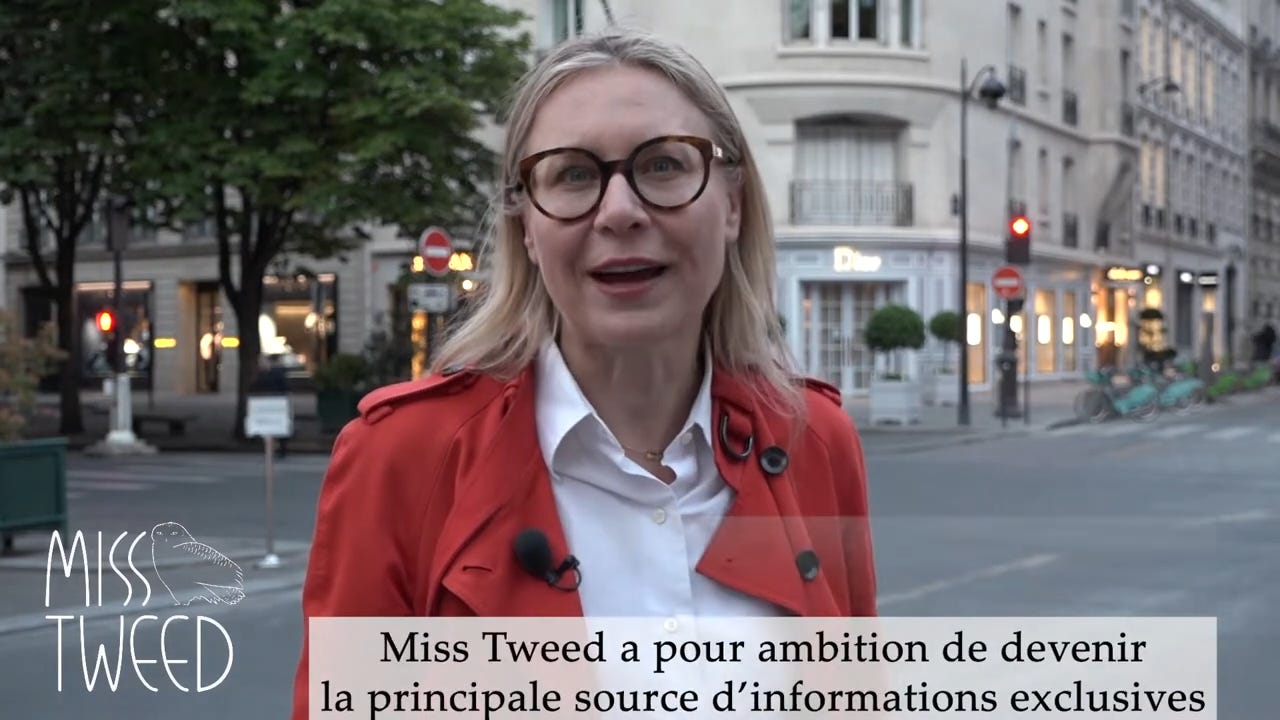
Astrid Wendlandt cut her teeth as a 21-year-old reporter in 1990s Moscow, and since then, never really left the frontier. What I admire is that she boldly calls the trade press that depends on advertiser goodwill “parrot press” — a term with the flat contempt of someone who spent fifteen years watching how the sausage gets, ahem, made, first at Reuters, then the Financial Times. Subsequently, she decided- pre-Substack- the only way to report on luxury honestly was to answer to subscribers instead of brands. Astrid, as many of us strive to, earned her independence- and no one can say it was easy.
Miss Tweed, the platform she launched in June 2020, inside the mid-pandemic frenzy, took French Ministry of Culture accreditation within months.No surprise here: her bold reporting has been arguing for a while now that the luxury industry’s golden age is ending, and that the conglomerates know it even as they hedge their bets in China or elsewhere. You heard it here first.
But I feel it’s her verdict on the industry itself that matters the most: behind the glitz, she says, is a jungle, run by executives with main-character-syndrome who think they’re “saving lives” — when really, in her words, they’re just selling trinkets to gullible customers buying a dream. What follows is a conversation with her covering everything, from her trips to the Siberian Arctic to her experience in the Paris showrooms-no contradiction here, she would note.
You launched Miss Tweed in June 2020, right in the middle of a pandemic, and within months, it received press accreditation from the French Ministry of Culture. What made you choose that turbulent moment to strike out independently?
I launched Miss Tweed because I did not want to work for media outlets that depend on advertising to pay journalists’ salaries. They are known in the trade as “parrot press”. The fashion and luxury industry has become one of the main pillars of the global economy. I thought there was a need for independent media to allow the free flow of information and serve as a platform for high-quality journalism.
Miss Tweed is advertising-free to guarantee complete editorial freedom. In an era where most media are either dying or dependent on brand money, how sustainable is a subscription-only, ad-free model in the luxury space?
This model is tested and approved. In fact, Miss Tweed is a profitable company, and this year it will pay dividends.
You spent over 15 years covering the luxury industry, mostly as European luxury goods correspondent for Reuters. What could you not say at Reuters that you can say at Miss Tweed?
At Reuters, like at Miss Tweed, I can say what I want. As with Reuters and my previous employer, the Financial Times, Miss Tweed is about fair, accurate and balanced reporting. We adhere to the highest standards of journalistic integrity and ethics. We never accept any gifts or free trips.
Your most recent analysis argues that the golden age of luxury goods is over — that the aspirational consumer is no longer interested in splurging on overpriced luxury items of dubious quality and ethics, preferring experiences. Is this a permanent structural break?
Yes I think the structural change is here to last and luxury and fashion groups have embarked on a major downsizing. They will sell brands, close boutiques and make hundreds of staff redundant. The process has already started as Miss Tweed reported.
You’ve pointed to China as a key market where the affluent now spend their money differently and on other things than Western luxury goods. Are the big luxury conglomerates — LVMH, Kering, Richemont — genuinely prepared for that reality, or are they still in denial?
They are not in denial of what is going on in China and many brands are already reducing their presence there. On the other hand, some brands such as Kering’s Saint Laurent are planning to open more boutiques in China and hold several events there.
Your book, How Luxury Conquered the World, was the result of a four-year investigation into the business of luxury. What was the single most surprising thing you uncovered in those four years?
It’s very difficult to say. This book shows that behind the glitz and glamour of the façade that fronts the luxury industry, it’s a jungle out there. Only the strongest survive. The problem is that many ultra-sensitive and creative souls work in the fashion and luxury industry, and they are not emotionally equipped to withstand the toxic environment you find at many brands.
Alongside your journalism career, you’ve spent over 20 years traveling in Russia’s Arctic region and the Urals and have written two books about those expeditions. What does a person who reports on couture and billion-euro conglomerates find in the Siberian wilderness?
I made these trips before I started covering the luxury and fashion industry. I think they have provided me with a precious and healthy distance from it. I have a lot of admiration for the work of designers but the fashion industry is a circus in reality. Many managers and executives have oversized egos and behave as if they were saving lives. But in fact they are just selling trinkets to gullible customers who buy the dream the brand is selling.